Of the five things I look for when hiring a senior product designer, this is the one I’d check if I could only check one.
This week’s video walks all five. Can they tell you why. Do they know what good looks like. Did they solve the right problem, or just the one they were given. Do they talk about how it should make people feel. And this one, which I named out loud as the one that matters most. It’s the last on the list for a reason: the other four can be taught. This one mostly can’t, and it’s what separates a good designer from the rest.
A quick note on scope before I get into it, because it’s load-bearing. This is written for hiring senior to lead. I wouldn’t expect a junior to think this way, and these things have to be taught, so go easy on junior to mid. But the five points are a seniority test. A junior who does two of them is promising. Somebody calling themselves senior who can’t do four of them isn’t senior, whatever the title says.
What I actually look for
At least one self-initiated project. It doesn’t have to have worked. It can be unfinished, it can be a failure, and if it turned into a business, better still.
Because to make something nobody asked you to make, you have to use every skill you have, get help with the ones you haven’t, and think about every part of it rather than the part you enjoy. The manufacturing, the money, the shipping, the boring bits. It’s almost always the best work in the portfolio, and their personality is all over it, because they had the problem themselves and worked out that if they had it, other people did too.
Emily Brooke left physics to study product design at Brighton. Cycling up to a junction, she wished she could be five yards ahead to warn the traffic, and thought she could project herself there instead. That was a final year project. It ended up on every bike in London’s hire fleet, and the company that came out of it is Beryl. Nobody briefed her. There was no client, no problem statement, no stakeholder asking for a laser.
Mine is smaller. I kept journalling on long distance walks and no notebook survived the weather, so I designed one that did, and now it’s a business. You can see it for yourself at thrunotes.co.uk.
Not everybody has a side project, and that’s fine
You’ll still see it in the work. There’ll be a range of projects across different parts of life for different kinds of people, because founders gravitate towards problems and they don’t much mind which industry the problem lives in. And the work will be a genuine step forward rather than a tidier version of what was already there.
When I was at A level, my tutor told us something I’ve never forgotten. She said, you’re designers, and you can change the world. Nobody had ever said anything like that to me before. And it stuck, because it’s true. You can invent things. You can change how people see something. You can make life better for a lot of people at once. I haven’t cured cancer or anything, but I reckon I’ve left a few things better than I found them, and that’s the person you want in the room.
What it looks like when it’s missing
The portfolio is small pieces of somebody else’s much bigger puzzle. Nothing is an invention. They won’t talk about the effect any of it had on a person’s life, and they won’t seem particularly excited that the job lets them make somebody’s day better, which is honestly the main reason to do it.
What that costs you is not obvious for a while. Good work still gets done and you’ll get through the quarter. You just won’t have a designer at the front of your business arguing for something better, and you’ll never see the version of your product that person would have built.
You’ll have hired a pair of hands. And a pair of hands is the one thing that stopped being scarce.
Why none of this is about AI
Everyone’s telling you to hire designers for their AI skills this year. Don’t.
If they think like a founder, the tools are already theirs. They found them before you asked. AI is the reason you can’t tell who’s good any more, because the polish, the artefacts and the case study page can now be produced by anybody in an afternoon. It isn’t the thing you’re looking for.
And this is the bit that took me a while to work out about my own job. I don’t do half of what I used to do. I don’t wireframe from scratch, I don’t cluster research by hand, I don’t build prototypes in Figma, and I don’t hand designs over to a developer. I hire AI, I delegate all of it, and I still do the job. That’s what a founder’s mindset looks like from the inside, and it’s the one thing on the list I’d genuinely check.
Try this
Next portfolio that lands on your desk, don’t try to judge the design. Just look for something they built that nobody asked them to build. That single question will tell you more than an hour of interview, and you can answer it in about ninety seconds.
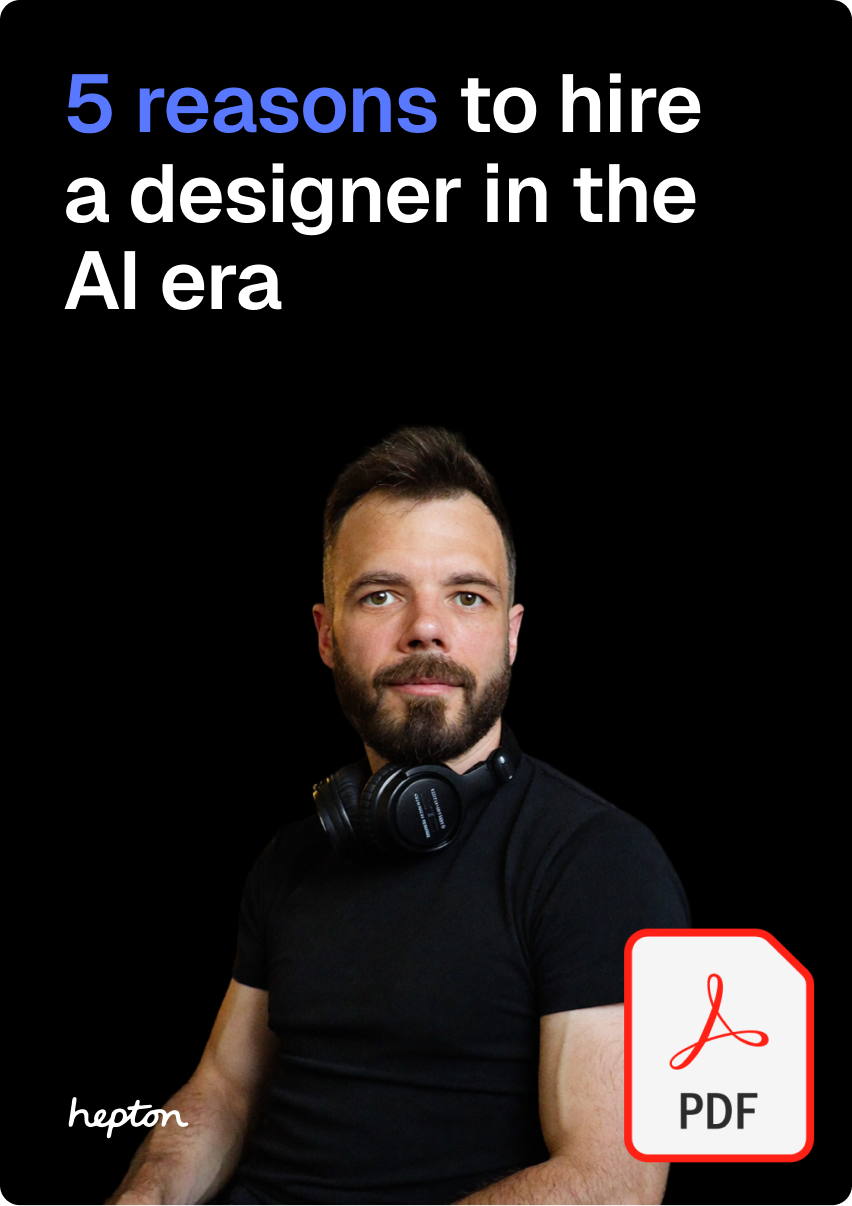
All five are in a free PDF, one per page, with what it looks like when it’s there and what it looks like when it isn’t. Get it by email from the newsletter page, and the full video is on YouTube.

Comments